

At the annual Waterfront planning infrastructure conference this week there were really only two questions on the minds of consultation and engagement professionals – would the changes to the planning process have the desired effect of speeding up delivery and what would the streamlining of consultation and engagement requirements mean for stakeholders?
The lawyers in the room (from Pinset Masons) were quite clear that the acceptance risk is still very much dependent on the extent to which the guidance had been followed. And that guidance still included and recommended pre-application consultation. The risks are lower and more indirect – but the jury is out on if a reduction of proper engagement might trigger something more serious. A range of broader risks with diluting pre-application stakeholder engagement were cited such as reputation damage, a failure to discover alternatives, the inability to recruit local expertise. Besides, there is a dose of common sense here. Planners will still benefit from discovering the main issues and unresolved issues somehow as well as reducing the risk of post-submission challenges.
Consequently the changes that are manifesting seem to be more a repositioning. For example, instead of dropping the creation of a Statement of Community Consultation, a lighter version can be made to help stakeholders with the framing. There is also a move away from reporting numbers and moving towards quality measures and being more relationship led. While no longer necessary, engagement reporting is still a good idea – but changes from ‘what we did’ to ‘here’s what we learned’. There was a sense that being more embedded, more face to face and more hyperlocal (even reverting to more traditional and less digital methods) was the answer to the new challenge.
All of this made us think very hard about Rewiring the State. We know that through this and the simplification agenda, the ambition for government is fewer duties and faster decisions. Yet we are also realistic – there are parts of the existing system (such as changing common law) that are simply not up for grabs and the delays are often at the door of decision making itself.
Other bodies have already done some thinking about this but our take is slightly different. While there are clearly areas where reform is needed (just think about redundancy or budget consultations), we do at least agree that a move to guidance and away from the statute can unlock some benefits. For example, a deeper level of community relationship-building as described above. We also don’t see this as a threat to our practice, if anything it comes with a reduced fear of unjustified judicial review from people who challenge the process because they don’t like the outcome.
We agree that capacity is being diminished but capabilities are being replaced at god speed – soon anybody will be able to prompt their way to a pretty decent consultation and output report. Not that specialist knowledge is surplus to requirements – just that new tools of the trade will free-up capacity for the experts to do more meaningful work.
To keep things simple, we think the priorities of any reform should be timeliness, proportionality and openness. On timeliness, the challenges are around starting early, visibility and co-ordination (e.g, dealing with overlapping consultations and cumulative impacts). It’s proportionality in which time can be saved – to engage or consult and to adjust the amount of process rigour by taking a risk based approach. On openness, it’s about transparency such as correct or standardised framing and access to information.
While we have many ideas in this domain but we’re repeating one here around the operating environment, change and method.
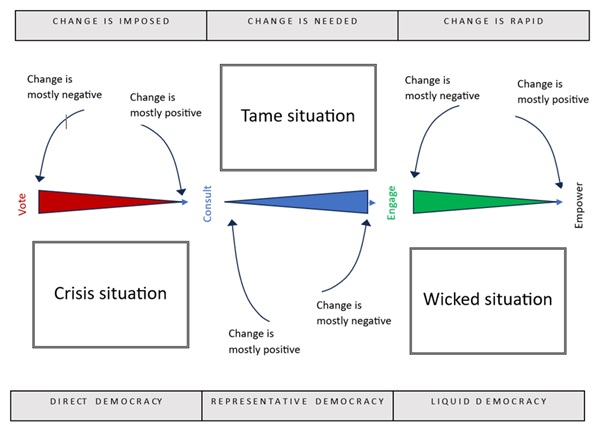
The curveball might be a new ‘Consultation Act’ or similar to replace the many and fragmented pieces of legislation which sets out the conditions/triggers and expected procedures for any given scenario such as those in the above model.
We even think there’s a place for more ‘test and learn’. At the moment, an experimental traffic order is the only mechanism whereby consultation comes after the change. Trials of a limited nature provide excellent impact evidence upon which to deliberate. With appropriate guard rails and an emphasis on public hearings, this could be the sequencing reform that is badly needed.
To conclude, more flexible duties with more consistent approaches and not just faster but more legitimate decisions is the holy grail. The inconvenient truth is that we only represent the profession – those who participate will know the real pain – that democracy is important to us, as is a culture of consultation, yet nobody wants to invest in it.