The IAP2 Spectrum of Public Participation is a globally recognised framework developed by the International Association for Public Participation. It defines the public’s role in planning and decision-making, mapping out five distinct levels of engagement that correlate with an increasing level of public impact on the final decision
The Spectrum (based on concepts from the 1960s – Arnstein’s Ladder ) was originally developed in 1999 and was in much need of a revamp. Existing tensions included the concept of hard levels and the words used to describe power, so IAP2 have been consulting on changing it. Trouble is, there is somewhat of a backlash with regard to how visible the consultation process has been – especially when the framework has been the backbone of practitioners for so long.
Meanwhile, the founder of ‘The Consultation Institute’ (pre-collapse) has been touting his ‘Four Functions Framework’ – also with a consultative approach but very much based on observational theory.
For the avoidance of doubt, we have our own frameworks too. While we champion the notion of good democracy through inclusive decision making, a lot of the time our goals are aligned to smooth change management. For example, updating a policy to implement some sort of new way of working – or the reconfiguration of services due to funding cuts. Decisions have impact. It’s no wonder that Arnstein’s Ladder has stood the test of time. A lot of organisations still strive for a holy grail involving some sort of devolved, embedded or shared power because this configuration allows them to change more quickly and with more built-in confidence.
So, thinking about this another way, It’s possible to merge another theory (the typology of problems power and authority -Grint,.2005) which concerns three situations – ‘crisis’, ‘tame’ and ‘wicked’. At one end of the spectrum, wicked situations involve lots of uncertainty. They are complex and require lots of involvement or engagement. In the middle, tame scenarios can be managed through rationality but with collective consensus. And during a crisis scenario you need quick decisions, hard powers or a temporary solution.
Mapping the change spectrum onto a participation spectrum you end up with the diagram below.
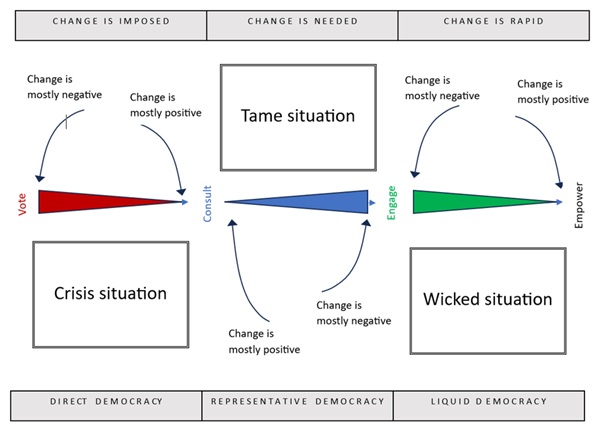
Assuming that the majority of the time we working a tame situation, we have a decision tree for consult or engage based on the nature of proposed changes. While this is a working model, some public organisations agree up-front on when to consult or engage. The most interesting example is the NHS which tends to consult only when changes are being made to the range or manner in which services are delivered.
Of course, there are many other dynamics at play such as the proximity of previous engagement activities and the impact of any proposed changes.
Delving deeper, the next question might be what methods to adopt. This has typically been a derivative of stakeholder mapping or who is to be targeted. However, it can also be viewed through the lens of that needs to be achieved. In the model below, we set out four types of activity : to Decide on something, to Debate something, to Discover something or Do something.
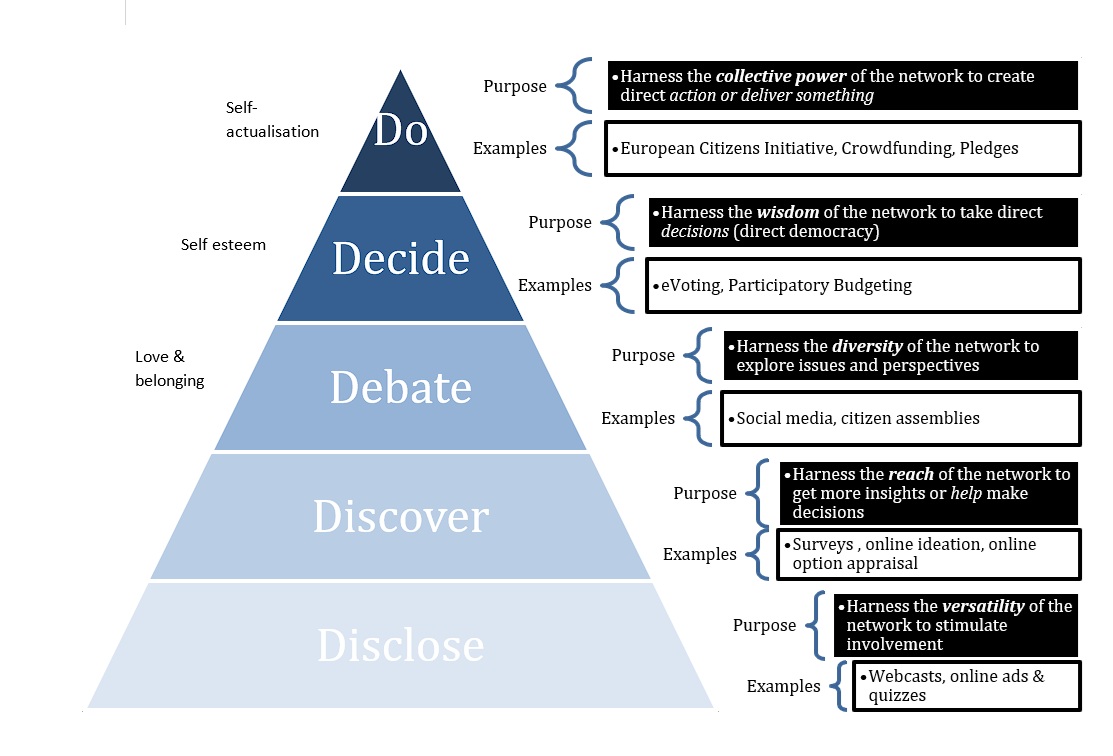
BUT untimately we’re not precious about any of this – because reality is rarely so linear. And while it’s good to put some theory behind our work, what we really care is about is careful execution. Ironically, very few people who live in a world of theory have actually been through the process. In our eyes, consultation and engagement is a wonderful muddle which really only cares about the positive imapct you have in the process of change.
This is a really thoughtful article and poses some great models for thinking and debating about! I think the issue in Australasia is that the IAP2 Spectrum is embedded = across all levels of government, it is referred to and almost universally forms the basis for Engagement or Consultation policy, strategies and plans. So changing it poses real risks for consistency and even undermining the good work to date (which is not to say that all engagement in Aus is great, or even good! But at least it happens). Another benefit of this process is that I am discovering organisations like this! So thank you!