We’ve already covered the sticky issue of using AI to make sense of consultation responses but rarely do we think about sensemaking in terms of helping participants understand other participants beyond active facilitation and consensus building.
Last week that changed a little in South Carolina following the launch of their online forum. To kick things off they posed a very simple question – “If South Carolina’s state leaders and residents could solve one problem, what should it be?” and as if by magic hundreds of ideas started to flow in.
All of this has been done with complete transparency – like the NHS 10-year plan consultation – whereby each participant can read, comment and vote on other participants ideas. Trouble is, it’s hard to digest such unstructured contributions, yet alone scroll through and read them all in lurker mode.
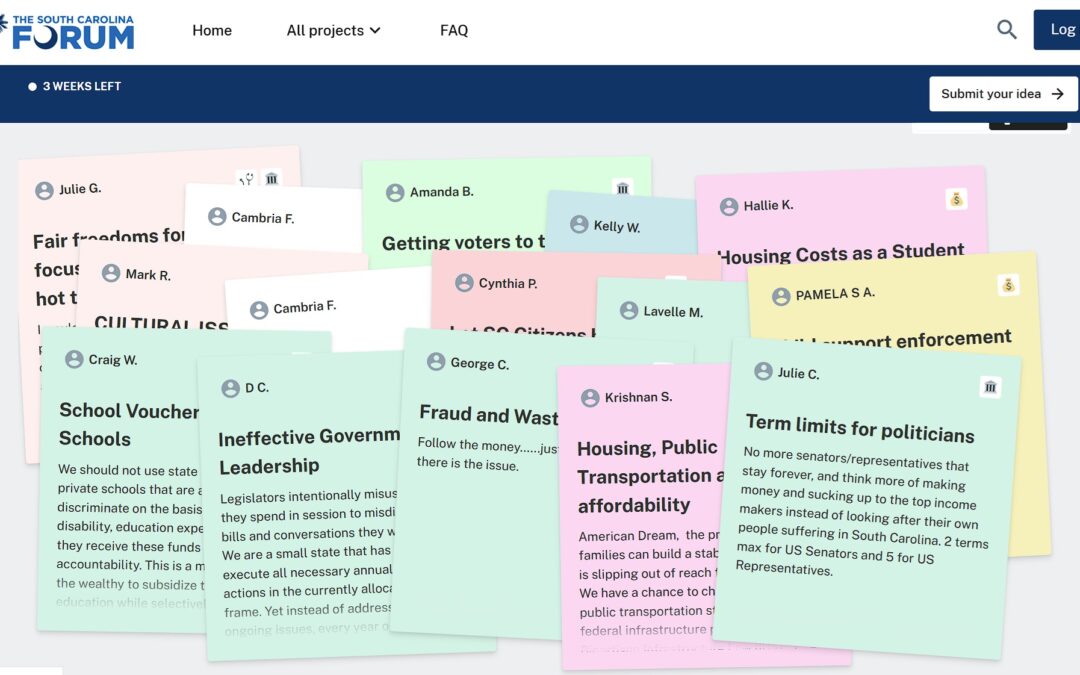
Which is why this consultation is a gem. They are presenting existing ideas back to participants using colour-coding and tagging based on AI analysis. Argument mapping is not new but has been the privilege of data geeks until now – and ‘real-time’ feels different.
Better still, the way that individual ideas are presented have a familiar ‘stick note’ look and feel. What’s more, there’s science at work in terms of the order in which ideas appear – taking into account different perspectives to break the echo chamber, ‘wise voices’ and even giving more prominence to ideas submitted by people with protected characteristics.
While this is a great experience for those engaged in the project, it doesn’t quite go as far as helping to identify which contributions might also be AI powered. And it’s with increasing sophistication that AI is being used to disrupt, with services such as https://www.objector.ai/ that can be used to generate credible objections to planning applications.
Clearly sensemaking is here to stay and it’s getting more sophisticated. No longer is it confined to helping organisations make sense of conversations, it’s here to raise the signal to noise ratio of messy questions. But challenges remain – ‘Are you human?’ is a question that should be on every consultation and engagement professionals’ lips.